


 Fashion for Ladies

Trapezoidal Psychedelica – FineWoodworking

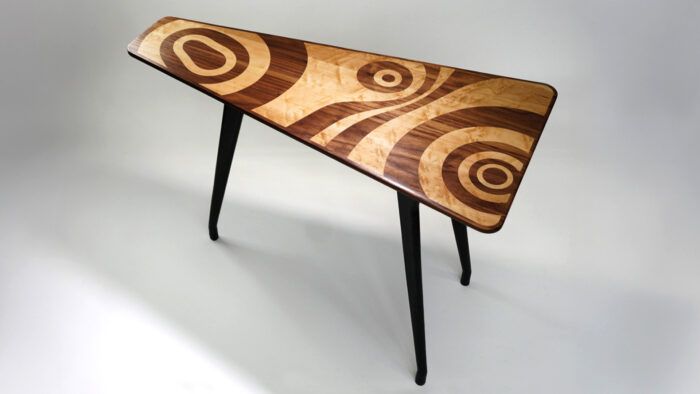
This week I want to show you a side table I just finished for a client. It’s designed to fit between two chairs and to hold drinks, books, snacks—the usual. The surface is shaped like a trapezoid.

Weird Little Object
Right off the bat it’s clear that this is a weird piece—small, asymmetric, a little aggressive. Not a polite rectangle trying to blend in, this thing’s more like a geometric sculpture that happens to hold drinks. And if you know me, you know that’s the sort of thing I love. The size and shape gave me permission to treat it less like furniture and more like an object.
It started with the top. The trapezoid came from the space—a little gap between two chairs—but once I committed to it, I saw it less as a constraint and more as a creative prompt. It’s got this stretched, directional quality to it, almost like a slice of something larger. There’s movement in the shape. I can’t help but think of it as being a little sci-fi and a little mid-century modern at the same time.
Three-Legged Alien Vibes
Since the top leans toward a triangle, three legs made the most sense. I’d developed a few leg shapes in a stool series last year—tall, slender, a little alien.


There’s something about the tension in those forms—like they might crawl away if you’re not watching. I brought that energy in here but kept the legs subtle: ash, sanded smooth, then dyed with India ink for a deep, matte black. Under the walnut top, they give the table an airy lift. With the smooth, shadowy finish and slender curves, they mismatch the top in a way that makes the top feel like a separate entity, floating or held in space.

Electrostatic Ornament
Then came the inlay. The pattern comes from the way protons and electrons create an electrostatic field in space. Each of the four points in the pattern—two of them close enough to form an oval—emits an invisible charge that’s tracked by zebra-striping the resulting field. I developed a system of mathematical and digital tools to be able to draw and adjust the patterns until I had what I wanted.

The result looks like a storm trapped in a box—an infinite pattern, cropped and framed. The dark walnut seems voided by the bird’s-eye maple, while each wood brings its own grains and figures that interact at the interface—the innie and the outie.
Construction
Making weird furniture calls for using weird construction techniques and inventing some new ones. Most of the shape-making work for this project was done on a CNC router, which takes computer code and translates it into a moving cutter that carves wood. However, that’s a far cry from pressing a button and having a table pop out of a printer like Mickey 17.
The top is a solid piece of black walnut into which I carved nine pockets—each 1/4 in. deep—with walls beveled at 7.5°. Similarly, I cut nine plugs tapered the other way. All the plugs were glued into the holes and created a tight fit that is held not only with the glue but also with the friction of the wedging action.

With all the plugs and pockets cut out, I could fit it together with some glue.

Once it was all set and dry, I planed away the excess material around the inlays to make a flush, continuous surface of two materials.

Final Form
This piece isn’t trying to be quiet or blend in—it’s staking out its own little patch of living room like a spaceship that landed between two chairs. And honestly? I love that.

To read more about Ari’s work, visit his Substack.
Fine Woodworking Recommended Products

Bahco 6-Inch Card Scraper
The size and thickness are what matter here. A consistent performer, this Bahco scraper is found in many shops we visit.
Whiteside 9500 Solid Brass Router Inlay Router Bit Set
Set includes solid carbide down-cut spiral bit (for chip-free cutting), quick-change bushing, template guide and complete instructions. Fits Porter-Cable, Black & Decker and any router with a Porter-Cable bushing adapter.
Sign up for eletters today and get the latest techniques and how-to from Fine Woodworking, plus special offers.