


 Fashion for Ladies

Scraps for a Cause – FineWoodworking

There’s no avoiding it. Woodworking generates a lot of scrap.
Here’s an example: When I turn bowls and platters, which I often do, I cut square pieces of solid or laminated wood into round turning blanks. Cutting a 12-in. circle from a 12-in. square produces about 31 sq. in. of scrap—over 20% of the square! Several years ago, as my pile of scraps was outgrowing my small shop, I was using scraps as kindling in the woodstove. It made me feel guilty each time I burned a beautiful piece of wood. Why didn’t I use my scraps? The problem seemed to be that most scraps were odd shapes and sizes and often were stored in cardboard boxes or on out-of-reach shelves. When I needed an extra piece for a project, it was nearly impossible to find something suitable. I finally realized that I needed a different perspective. Instead of looking at the scraps as auxiliary pieces, I should design projects using them in the main role.
My woodworking experience began in the 1960s when I was in high school and worked summers at a factory where my father was foreman. It was a production shop, so I often had to drill, cut, or sand hundreds of pieces. I learned machine use and how jigs and fixtures were important for accuracy, efficiency, and safety. After graduating college, I spent my career teaching woodworking. Now retired, I spend as much time as possible in my home shop.
In recent years most of my woodworking has been focused on raising money for education programs in Kenya. That’s because in 2004 my wife, Jean, and I read about how schools were becoming free in many African countries but were overcrowded, often with 100 students in a class. In response, we started a nonprofit, Grow Against Poverty, partnering with a similar one in Kenya, to support school programs.
Some of the programs we help fund are Pedal Power for Kenyan Education, which provides bicycles for students who live five or more miles from school; Prevent Period Poverty, which supports girls who miss school when they have their periods by building bathrooms, distributing menstrual products, and adding health-education classes to the curriculum; and Green Fields, under which organic gardens tended by students produce vegetables for school lunches.

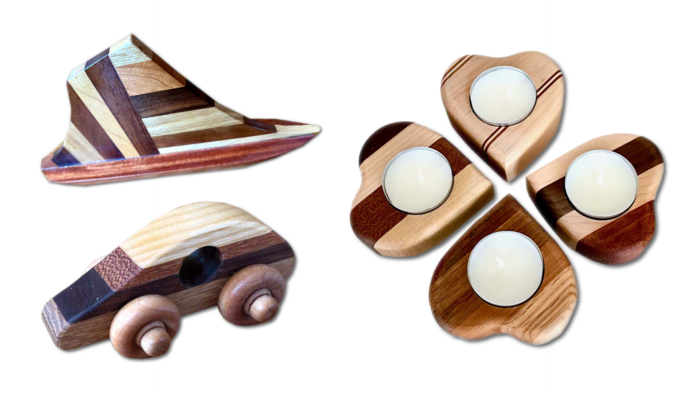
I began using my woodworking skills to raise money for the effort, making small items in batches and selling them in stores and in a holiday sale. Once I started thinking of projects I could make from scrap, they began to fill my sketchbook. My cutoff corner scraps—triangular pieces with a concave curved side—reminded me of sails, and as I was making toys for a holiday sale, I decided to produce sailboats. As it turned out, most were purchased not as toys but as display pieces for people who love to sail. Heart-shaped candleholders are another project I make out of corner castoffs. They sell so well that sometimes I run out of corners and have to glue up strips of scrap to make my usual run of 50 hearts. I also use corner scraps to make mini cars. My newest “corner project” is cell phone holders.
When I have leftover hardwood strips, I do what I often had my junior and senior high school students do: make cutting boards. Other strips I use to make spatulas, salad servers, chopsticks, hair sticks, gua sha massage tools, and jewelry.
These days, it’s easy to answer when someone asks, “What are you making in your shop?” There are many projects to describe, and fewer scraps in the woodstove.
John Roccanova works wood in Ancramdale, N.Y. You can see more of his work on Instagram @woodcrafts4acause.
Photos: John Roccanova
Fine Woodworking Recommended Products
Suizan Japanese Pull Saw
A versatile saw that can be used for anything from kumiko to dovetails. Mike Pekovich recommends them as a woodworker’s first handsaw.
Sign up for eletters today and get the latest techniques and how-to from Fine Woodworking, plus special offers.